Finding a dependable front door repair supplier in China requires more than comparing prices. A damaged entrance may hide warped frames, loose hinges, worn weather seals, or a failing lock body. Each defect needs a different solution. The right supplier should understand these details and explain them clearly.
Tom Silva, a veteran contractor and door-installation specialist, has often emphasized, “A door is only as good as its installation.” That practical point applies to repair work too. A strong supplier should provide material specifications, repair photos, production details, and clear quality checks. Ask whether the factory handles solid wood, steel, aluminum, or composite doors. Request samples when color, grain, or hardware finish matters.
Look for suppliers with documented experience in front door repair, not only general door manufacturing. Their technicians should identify the original failure instead of covering it temporarily. Check hinge alignment, threshold height, drainage paths, seal compression, and lock compatibility. Small measurements matter. A two-millimeter error can cause rubbing, drafts, or repeated callbacks.
Communication is another test. Reliable teams answer technical questions with drawings, measurements, and realistic lead times. Vague promises are warning signs. Factory audits, customer references, and independent inspection can reduce uncertainty. Still, no sourcing process is perfect. Even experienced buyers can overlook packaging damage or installation differences. Build a written inspection checklist, confirm every revision, and allow time for corrections. The cheapest quote may become expensive after rework, delays, and unhappy customers. Good sourcing feels slower at first. It usually saves trouble later.
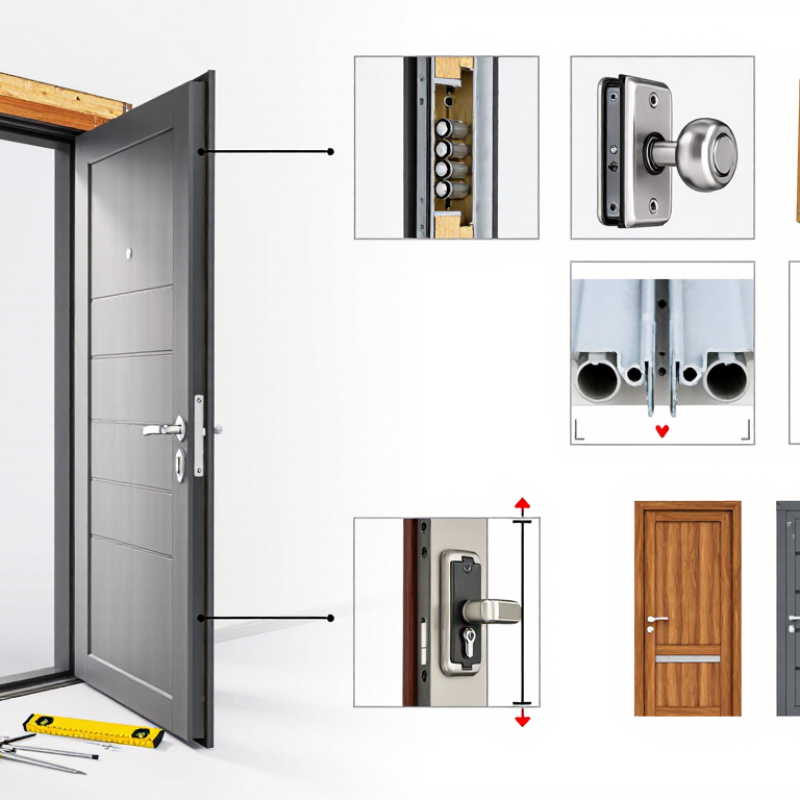
When choosing front door repair suppliers in China, define the door before requesting a quotation. Steel security doors, fire doors, wooden doors, and aluminum doors require different tools and replacement parts. A 2024 market report by Mordor Intelligence estimates that China’s doors and windows market will expand at roughly 5% annually through 2029. This growth brings more suppliers, but also uneven technical capability.
Describe the failure mode precisely. Common problems include frame distortion, hinge sagging, latch misalignment, lock-cylinder failure, corrosion, damaged seals, and loose panels.
A practical repair brief should include door thickness, frame depth, opening direction, hardware photographs, and failure history.
For steel security doors, ask suppliers to reference GB 17565-2007. The standard covers security performance, door construction, lock protection, and resistance testing. It does not automatically prove fire performance or installation quality. That distinction matters.
Request a repair method statement, replacement-part specifications, inspection records, and post-repair testing steps.
Suppliers should explain whether they will straighten the frame, replace the lock body, reinforce fixing points, or install a complete door leaf.
UN Comtrade data consistently identifies China as a leading exporter of base-metal door hardware, yet export scale cannot confirm repair expertise.
We have seen quotations that look complete but omit frame tolerances. A perfect checklist is impossible.
Require measurable acceptance points, such as smooth closing, stable latch engagement, uniform gaps, and documented alignment after repeated opening cycles.
How to Find the Best Front Door Repair Suppliers in China?
A reliable supplier screening process begins with ISO 9001:2015 verification. Ask for the current certificate, certification scope, and issuing body details. The registered company name should match the factory license and quotation. Check whether the scope covers manufacturing or repair-related hardware. An expired certificate is a serious warning. A certificate alone proves little.
Review the supplier’s business license and confirm its legal representative, registered address, and operating status. The workshop address should match the audit location. Request export records covering at least three years. Customs declarations, bills of lading, and commercial invoices can show real transaction experience. Check product descriptions, shipment frequency, and destination markets. Records should be consistent, not simply impressive. In supplier audits, I have learned that paperwork may look polished while production control remains weak. This is where careful inspection matters.
Tips: Ask for redacted shipping documents. Contact the certification body independently. Compare export records with factory capacity. Visit the workshop if possible. Inspect hinge samples, repair kits, packaging, and final inspection notes. Photograph batch labels and storage conditions. I once focused too heavily on certificates and missed poor corrosion testing. That mistake still influences my checklist. Allow room for doubt.
| Screening Dimension | Evidence to Request | Objective Acceptance Standard | Verification Method | Weight | Status |
|---|---|---|---|---|---|
| ISO 9001:2015 Quality Management System | Current ISO 9001:2015 certificate showing the legal entity, registered address, certification scope, certificate number, issue date, expiry date, and certification body. | Certificate is current, scope covers manufacturing or supply of relevant door repair products, and the legal entity matches the business license. | Check the certificate number in the certification body’s public database where available. Confirm the certification body’s accreditation status. | 25% | Verify |
| Chinese Business License | Current business license, unified social credit code, registered capital, legal representative, establishment date, business scope, and registered address. | License is active; business scope is compatible with hardware, doors, building materials, repair parts, or related manufacturing and trading activities. | Compare the license information with the official Chinese enterprise registration system and the contract entity. | 20% | Verify |
| Three-Year Export History | Redacted customs declarations, commercial invoices, bills of lading, packing lists, or customer reference records covering the latest three completed calendar years. | At least three consecutive years of export activity for comparable door hardware or repair products, with consistent legal-entity details. | Cross-check dates, product descriptions, consignee details, shipment frequency, and document consistency. Sensitive prices may be redacted. | 20% | Verify |
| Product Compatibility | Product catalogue, technical drawings, material specifications, dimensional tolerances, compatibility charts, and repair instructions. | Supplier can provide dimensions, materials, finishes, installation requirements, and compatibility information for the requested door system. | Compare technical documents with a pre-production sample and the buyer’s drawings or approved specification. | 10% | Verify |
| Material and Surface Quality | Material declarations, coating or plating specifications, corrosion-resistance test reports where applicable, and inspection records. | Materials and finish must match the purchase specification; inspection records must identify lot numbers and inspection dates. | Perform incoming inspection, dimensional checks, finish inspection, and sample-based functional testing. | 10% | Verify |
| Production and Inspection Controls | Process flow chart, quality-control plan, inspection checklist, calibration records, nonconformity procedure, and corrective-action records. | Documented controls exist for incoming materials, production, final inspection, traceability, and corrective action. | Review records during a remote or on-site audit and verify that records correspond to actual production processes. | 5% | Verify |
| Supply and Delivery Capability | Monthly capacity statement, standard lead time, minimum order quantity, packaging specification, and production scheduling process. | Capacity, lead time, packaging, and minimum order quantity are stated in writing and accepted before purchase order approval. | Confirm capacity using historical shipment frequency, production records, and a trial order. | 5% | Verify |
| Commercial and After-Sales Controls | Quotation, payment terms, warranty terms, replacement policy, complaint-response procedure, and product liability responsibilities. | All commercial terms are documented, consistent with the contracting entity, and include a defined response and replacement process. | Review the sales contract and confirm the process using at least one verifiable customer reference where permitted. | 5% | Verify |
| Decision Level | Weighted Score | Required Conditions | Recommended Action |
|---|---|---|---|
| Approved for Trial Order | 85–100 | ISO 9001:2015, active business license, and three-year export history are independently verified. | Request samples, confirm specifications, and place a controlled trial order. |
| Conditional Review | 70–84 | Minor documentation gaps exist, but product and production evidence is generally acceptable. | Require corrective documents or an audit before placing an order. |
| Reject or Re-screen | Below 70 | A mandatory document is missing, expired, inconsistent, or cannot be independently verified. | Do not release payment or purchase orders until the supplier passes a new review. |
Mandatory hold point: Do not treat a supplier as qualified until the ISO 9001:2015 certificate, active Chinese business license, and three consecutive years of relevant export evidence have been checked against consistent legal-entity information.
Finding a front door repair supplier in China starts with test evidence, not catalogue photos. EN 1627 classifies burglary resistance from RC1 to RC6. Ask for the complete test report, not only the rating page. Confirm that locks, hinges, frames, and seals match the tested door assembly. A stronger lock cannot compensate for a weak hinge side.
Check whether testing followed EN 1628, EN 1629, and EN 1630. These standards examine static load, dynamic impact, and manual attack resistance. Request photographs showing hinge bolts, cylinder protection, compression seals, and latch engagement. A useful audit detail is the tested door size. Changing the leaf width or hardware can invalidate the original result. This is easy to overlook.
Fire performance needs separate evidence. EN 1627 does not prove fire resistance. Ask for EN 1634-1 testing, including integrity and insulation periods, such as 30, 60, or 90 minutes. NFPA’s Fire Loss in the United States During 2023 report recorded about 1.39 million fire incidents, showing why fire-door claims deserve careful verification. Suppliers should provide laboratory identity, report number, test date, and scope. Verify them directly with the laboratory where possible.
A certificate alone can mislead. I would also order a sample and inspect seal compression with a feeler gauge. Small gaps matter. Supplier explanations sometimes sound confident, but the hardware schedule may disagree. That is where the real review begins.
Finding the best front door repair supplier in China requires more than choosing the lowest price.
Request at least three written quotes. Specify the exact parts, door model, finish, packaging, and delivery address. Ask suppliers to separate production, inspection, and transit times.
UNCTAD’s Review of Maritime Transport 2023 reports that over 80% of global trade by volume moves by sea. Port delays can therefore change the real lead time.
The World Bank’s 2023 Logistics Performance Index ranks China 19th globally, but regional performance still varies. Details matter.
Create one comparison sheet for every quotation. Record lead time, warranty length, MOQ, tooling fees, payment terms, and spare-part availability.
A 12-month warranty may exclude installation damage or corrosion. Request the exclusions in writing.
Compare one sample order with 100 repair sets. A low MOQ can hide a higher unit cost. It happens.
For 24-hour support, send the same technical question at night. Measure the first response, escalation path, and replacement process.
“Online anytime” is not a service-level promise.
For reliable verification, request a business license, factory or workshop photos, inspection records, and a physical sample.
An ISO 9001 certificate can support process control, but it does not guarantee repair quality. Check dimensions yourself.
I would score lead time at 30%, warranty at 25%, support at 25%, and MOQ at 20%.
This weighting may not fit every project. Large commercial doors need stricter testing and documentation.
A common purchasing mistake is accepting a polished quotation without confirming packaging, local compliance, and after-sales evidence.
How to Find the Best Front Door Repair Suppliers in China?
Approving a front door repair supplier requires more than reviewing a catalog. In my supplier audits, I request sample repairs before discussing large orders. The supplier should repair a damaged door panel, replace a hinge, and adjust the locking position. Each task reveals practical skill. Ask for measurements, material details, labor time, and repair photographs. A reliable workshop explains its methods clearly.
Inspection data should support every claim. Check frame alignment, surface finish, hinge movement, seal compression, and opening force. Use the same checklist for every sample. Record results in millimeters, not vague phrases like “good quality.” A small inspection mistake can distort the decision. I once accepted a clean sample before checking repeated use, which exposed loosened hardware later.
Contract KPIs should convert expectations into measurable duties. Set targets for repair accuracy, delivery timing, defect rates, response speed, and replacement handling. Require inspection records with each shipment. Define acceptable tolerances and corrective deadlines. Payment terms can connect to verified results, not promises. Include a review process for recurring failures. A supplier may pass one sample and still struggle with volume. That gap needs monitoring. Reliable approval is built through evidence, repeated testing, and honest adjustments.